Find Your People

Finding Your Pipe Band

Playing the pipes alone is one kind of pursuit. Playing with a band is a different one entirely. Here is how to find a band near you, and why you would want to.

The piping world is smaller than the internet makes it look. Almost every band is reachable in one or two steps once you know where to look.

Why Join a Pipe Band?

Most beginners stumble into piping expecting a solo hobby. You practice in the basement, you progress in private, maybe you play at a cousin's wedding. That path exists, and for some people it is the whole point. But for a lot of pipers, the real unlock is joining a band. Most of them did not know that was what they wanted until they were already in one.

Here is what a band actually offers that YouTube and a practice chanter cannot. Free or near-free lessons, often taught by people who have been playing for thirty years. Weekly practice nights that turn "I should work on this" into "we worked on this together Tuesday." Instrument loans while you decide whether you are going to stick with it. Playing alongside other pipes and drums, which sounds fundamentally different from playing alone. The instrument is designed to be part of a corps, and you do not fully hear what it is until you are in one. Rides to Highland Games. A built-in calendar of things to work toward. And, not least, people who care whether you got better this month.

The social part surprises new pipers the most. Pipe bands tend to be multi-generational in a way that most modern hobbies are not. You will stand on a parade line next to a retired welder, a middle-school teacher, a college student, and someone who started playing three years ago at sixty-two. There is a shared language, a shared set of tunes, a shared idea of "we are doing this together." That kind of experience is harder to find than it used to be.

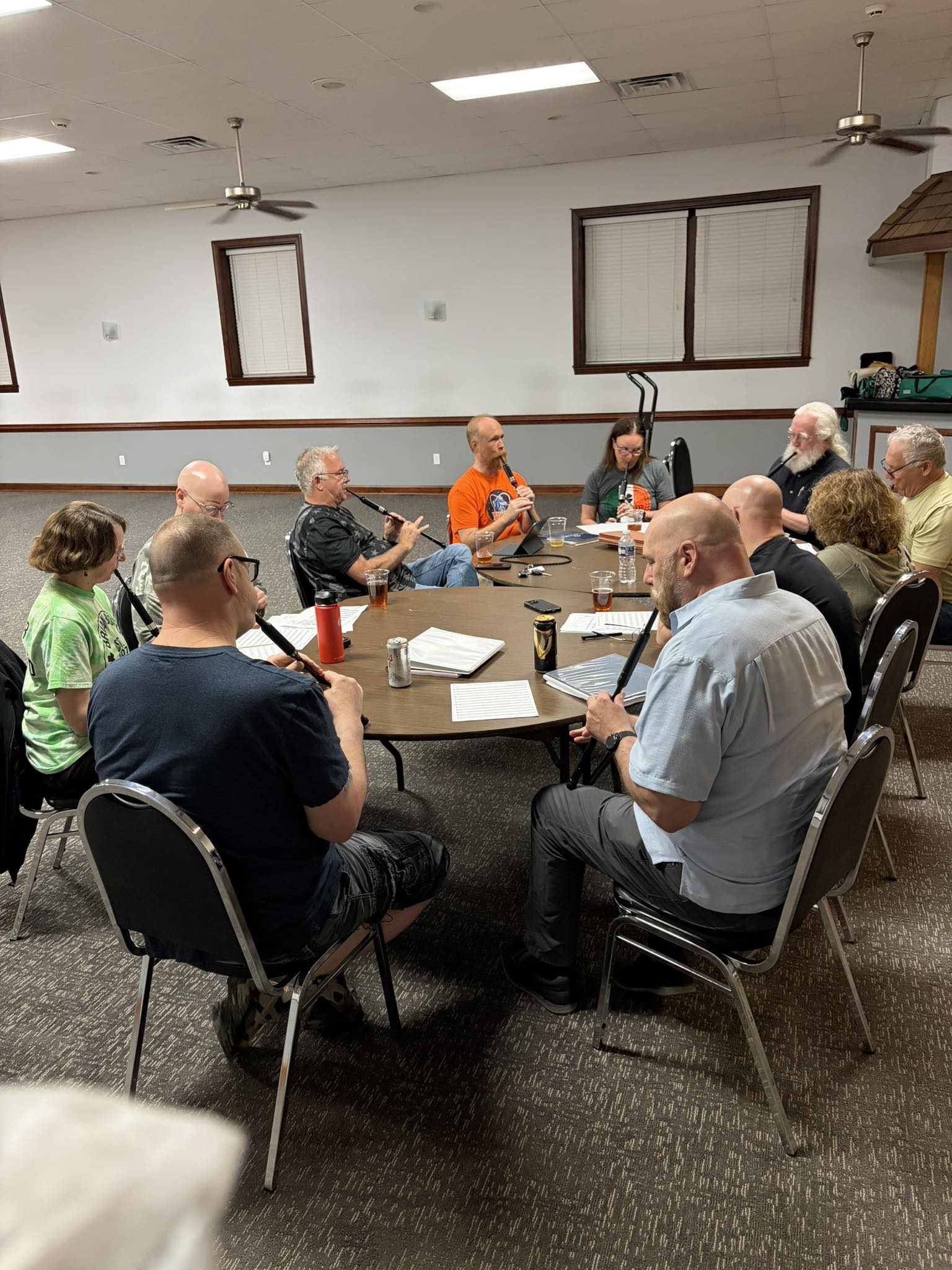
A pipe band practice session in a community-hall setting. About ten people of mixed ages are seated around a round table, most holding practice chanters, with water bottles and mugs on the table between them.
A typical weekly band practice. Practice chanters, folding chairs, a round table, and people of every age working on the same tune. This is most of what band life actually looks like.

Eight Ways to Find a Band Near You

Ordered roughly from highest signal to most serendipitous. Any one of them can work. In combination, they almost always do.

01

Start with the regional association rosters

This is the highest-signal starting point if a band in your state is affiliated to a United States Pipe Band Association (EUSPBA, WUSPBA, or MWPBA). Association member rosters tend to be current, with working website links and contact info. If nothing else, call up the association and tell them specifically what you are looking for. You will find the bagpipe world eager to engage with new bagpipers. See the full list of associations along with their links below.
02

Search Google with the right terms

Association rosters only catch competition-affiliated bands. For everything else, try these search strings with your city, region, or state swapped in:

[your city] pipe band, OR, [your city] pipes and drums, OR, [your region] bagpipes, OR, [your state] pipe band association

Look for actual band websites. Some only live on Facebook, and others only live on YouTube with their collections of videos. Whichever path you follow, dig through to find those band names, key contacts, or connection points you can google further. Remember, you are just looking for one contact who can then refer you on to the band you eventually join.

03

Walk the tent line at a Highland Games

Attend a local Highland Games as a spectator. Bands compete, bands march, and bands set up tents. Walk the tent line and ask every band "do you take beginners?" The answer is yes more often than not. Games season in the US runs roughly May through October, though southern states like Florida hold games as early as February, March, and April. Regional games schedules are easy to find. One good Saturday can solve this whole question.

04

Watch a St. Patrick's Day parade or pub crawl

Parades feature bands you can reach out to on the Monday after. Pub crawls and smaller community festivals around March 17 often feature bands that do not advertise anywhere else. Write down the band names from the program, from the banners, or from the bass drum. If you see a bagpipe band playing in your neighborhood parade or local Irish bar, chances are they are close to where you live.

05

Ask at a kilt shop or Celtic cultural center

Owners of kilt shops, Scottish and Irish import stores, and Celtic cultural centers know the local piping scene. They know which bands are active, which have quietly gone dormant, and which are actively hunting for new pipers. Scottish Heritage Societies, Sons of Scotland camps, Irish cultural associations, and Caledonian Societies are the same story. Email the board or call. Don't be shy. Just ask.

06

Check locally-owned music stores

Hit or miss. Chain-store staff generally will not know. But locally-owned stores that stock Celtic instruments (tin whistles, bodhráns, harps) often know the local pipers. Any music store that sells practice chanters is worth a visit. If nothing else, they may put you onto a bagpipe instructor they know, who then becomes your key to a bagpipe band.

07

Attend a bagpipe workshop, seminar, or beginner class

Weekend workshops and short-course seminars are often run through local bands, and attending one is the fastest way to meet pipers in a concentrated space. Winter months are prime workshop season in the US. Even if you do not end up joining the hosting band, the pipers you meet will know every band within two hours. Play the role of a newbie. Everybody loves newbies.

08

Ask the internet directly

The r/bagpipes subreddit is small but active and friendly. "Any bands in [region]?" posts regularly get useful answers from locals. Facebook groups and the forums at Bob Dunsire's site are slower but also work. In fact, send us an inquiry while you are at it. We will do our best to help get you situated.

Regional Pipe Band Associations

The three US associations below, plus the North American umbrella, cover the majority of competition-affiliated pipe bands on the continent. For beginners, these are the cleanest starting points.

EUSPBA heraldic seal: circular emblem with bagpipe illustration and 'Eastern United States Pipe Band Association' text around the rim
EUSPBA
Eastern US Pipe Band Association

Maine to Texas. Yes, really. EUSPBA is the largest pipe band association in the world by geography and individual membership, with six branches covering the Atlantic seaboard, the Southeast, the Ohio Valley, and the Southwest (Arkansas, Louisiana, Oklahoma, Texas). Formed 1964. Member-band list is current.

www.euspba.org →
WUSPBA logo: dark green circle with crossed white bagpipe drones and 'Western United States Pipe Band Association, est. 1963' text
WUSPBA
Western US Pipe Band Association

The American West. Washington, Oregon, California, Nevada, Arizona, and the Mountain states. Split into a Northern Branch (Northern California and Northern Nevada) and a Southern Branch. Maintains a directory of member bands, contest schedules, and scholarship programs.

wuspba.org →
MWPBA logo: heraldic Scottish-style crest with 'Midwest Pipe Band Association' curved text surrounding a bagpipe illustration with belt-and-buckle motif
MWPBA
Midwest Pipe Band Association

The American Midwest. Illinois, Indiana, Iowa, Kansas, Michigan, Minnesota, Missouri, Nebraska, North Dakota, Ohio, Oklahoma, South Dakota, Wisconsin, and Arkansas. Formed 1964. Around thirty member bands with roughly 300 individual members. Sanctions contests throughout the region.

www.mwpba.org →
ANAPBA logo: Canadian and American flags flanking 'ANAPBA' in large Celtic lettering with 'Alliance of North American Pipe Band Associations' below
ANAPBA
Alliance of North American Pipe Band Associations

The continental umbrella. Ties together the three US associations above plus six Canadian associations (Alberta, Atlantic Canada, British Columbia, Ontario, Prairie Manitoba, and Saskatchewan). If you are unsure which US region you fall under, or your search crosses the border, ANAPBA is the cleanest meta-directory.

anapba.org →
A note on Canada

Canadian piping coverage through ANAPBA is the best pointer we have at the moment. The six Canadian member associations (Alberta, Atlantic Canada, British Columbia, Ontario, Prairie Manitoba, Saskatchewan) each run their own member-band lists and contest circuits. A Canada-specific guide is on our list for a future release.

What These Directories Miss

The associations above cover competition-affiliated pipe bands. That is a real and useful slice of the US piping world, but it is only a slice. Non-competing community bands, fire-department and police memorial bands, church bands, St. Patrick's-Day-only bands, Caledonian society bands, and ad-hoc regional groups often do not appear on association rosters at all. Some of those bands are among the most welcoming places for a beginner.

If you cannot find a band through the associations, the in-person channels above (Highland Games, parades, kilt shops, cultural centers) often turn up ones that are not indexed anywhere on the internet. That is not a bug. It is just how the piping world works.

We are also deliberately not sending you to pay-to-list aggregator sites. A few exist. They tend to have stale data and paid-placement incentives that do not serve beginners. Better to work from the associations above and build out from there.

List a Band, Find a Band, or Just Ask

We are not a band directory yet, but we are heading there. If you are in a band that wants to be listed when we build it, send us the basics. If you are looking for a band near you and the eight methods above did not get you there, tell us where you live and what you are looking for. If something else is on your mind, that works too.