The instrument is called a warpipe for a simple reason. For four centuries, these instruments went to war. The people who carried them did not always come back.
If you have been piping for a while, you have probably heard the Great Highland Bagpipe called a warpipe and not given it a second thought. It is one of those words that sits in the tradition without anyone quite explaining where it came from.
The short answer is that for most of its recorded history, the Great Highland Bagpipe was not only a civilian music instrument. It was a piece of military equipment. Pipers marched at the head of columns, carried signaling tunes into action, and led troops on and off the field for about four centuries. The word warpipe is not a metaphor. It is a plain description of what the instrument was for.
What "warpipe" actually means
The Gaelic name for the Great Highland Bagpipe is pìob mhór, which translates as "great pipe," not "war pipe." The English word warpipe is a separate coinage that grew up alongside the instrument's military career. It appears in English sources from at least the 16th century, and by the 19th century it had become the standard term in British military usage to distinguish the louder, drone-heavy Highland pipes from the many smaller, quieter bagpipe traditions that existed across Europe. Irish pipers have their own parallel tradition, the píob mhór or Great Irish warpipes, used by Irish regiments through the same period.
The word also did some quiet cultural work. By naming the instrument for its battlefield role, it set the Highland pipe apart from the parlor and shepherd bagpipes that existed in Northumbrian, French, Bulgarian, and Galician folk traditions. Those instruments were for a room, a dance, or a hillside. This one was for a regiment.
The piper was infantry
It matters, for what follows, that a regimental piper was not a musician attached to soldiers. He was a soldier who played the pipes. The pipes were his weapon in the way that a bugle was a bugler's weapon: a tool for doing the work of war. Pipers drew the same pay as riflemen, wore the same uniform, and until roughly the First World War they marched at the head of the column into fire.
Pipes had a practical job on a battlefield built around sound. Before field telephones and radios, a battalion on the move coordinated by bugle, drum, and pipe. A piper's tune could carry half a mile over the noise of an 18th-century line. Pipers signaled the advance, signaled halts, led troops across ground they would not otherwise have crossed, and played their units back home when the fighting was done. Scottish and Irish regiments built their identities around the sound in a way that French and Prussian units built theirs around the drum.
The history is long enough that any short list is unfair to what it leaves out. Pipers led Scots at Pinkie Cleugh in 1547. They were at Killiecrankie in 1689 and at the Boyne in 1690. They were at Culloden in 1746, the battle whose aftermath gave rise to the Act of Proscription myth that bagpipes were outlawed as instruments of war. (They were not, as a matter of statute. That is a different essay.) Pipers were at Waterloo in 1815, in the Crimea in the 1850s, at Dargai in 1897, and across every major British engagement of the 19th century. By the time the 20th century arrived, the pipes had a four-century track record as a military instrument, and a reputation that did not need a manual to explain.
What the sound did to the men who heard it
The signaling job is the part you can put in a manual. Carry the tunes, mark the advance, mark the halt, take the men back home. The other part is harder to put on paper, and it is the part the pipers themselves talked about most.
Harry Lunan went over the top at High Wood in 1916 playing "Cock o' the North," with men falling around him. He later called the whole thing "stupid as hell" and "bloody horrible." He also said this: "Hearing the pipes gave the troops courage." That is the part. The instrument was not background music. It pulled men forward who would otherwise have stopped.
Historian Yvonne McEwen has called the pipes "a way of driving the men on" and noted that the Germans across the wire knew exactly what the sound meant. They listened for it the way you listen for an engine starting. The same effect shows up much later in much smaller wars: a former UN commander told the UK Parliament that bagpipes gave frightened soldiers in a largely English unit the courage to cross no man's land in Bosnia. The unit was not Scottish. The piper was. The story is the same as Lunan's, eighty years on. Bill Millin's son said the same thing in plainer language when asked about his father: "The bagpipes have a great tradition of going into battle because it stirs the troops. It made them feel that little bit braver."
The other side of the warpipe reputation is the side facing the enemy. German troops in the First World War gave kilted Scottish units a nickname that survived into Allied propaganda and a hundred subsequent retellings: "Die Damen aus der Hölle," the Ladies from Hell. Whether that exact phrase was common in actual German trenches is harder to confirm than the story usually suggests. Historians who have looked for it in original German-language sources have not found much. Most of what survives is British and later. The phrase belongs to the reputation rather than to a confirmed German document.
The underlying claim, though, is well attested in period accounts. The combination of kilts, a charge, and the sound of pipes meant trouble was coming, and the people on the other side of the wire understood it. Part of that was the sound itself. European armies of the period coordinated by drum and bugle, both of which sound roughly like other drums and bugles. Pipes do not sound like anything else on a battlefield. They are loud, they are continuous, and the harmonies do not sit comfortably next to brass and percussion. When you are dug in and the noise coming at you is unfamiliar, your nervous system spends extra effort working out what it is. That is not effort you want to be spending while a charge is forming up across the wire.
So the name was earned twice. Once by the men carrying the pipes forward, and once by the men on the other side, hearing them come. The First World War put names on a lot of those men. Three of those names are worth telling.
Daniel Laidlaw at Loos, 1915
On 25 September 1915, the British launched the Battle of Loos into a gas cloud of their own chlorine that the wind failed to carry. The 7th Battalion, King's Own Scottish Borderers, were waiting in the forward trench for the order to advance. The gas was drifting back on them. The men were coughing, retching, and in places refusing to climb the ladders.
Piper Daniel Laidlaw, aged 40, climbed up onto the parapet of his own volition, turned his back to the German line, and began to walk up and down the top of the trench playing "Blue Bonnets Over the Border." He did this in full view of German machine-gunners. When his company started to move, he walked out in front of them playing "The Standard on the Braes o' Mar." He kept playing until he was wounded in both legs.
He was awarded the Victoria Cross and the French Croix de Guerre. The press called him "The Piper of Loos" and his story was one of the most widely circulated acts of British valor of the early war. He survived, returned to Scotland, and worked the rest of his life as a laborer.
James Richardson at the Somme, 1916
A year later and four hundred miles south, a 20-year-old Canadian piper named James Cleland Richardson went over the top with the 16th Battalion of the Canadian Expeditionary Force at Regina Trench, on the northern shoulder of the Somme. Richardson was Scottish-born, raised in Vancouver and Chilliwack where his father was Chief of Police. He had asked his commanding officer for permission to pipe his company into the attack. Permission had been granted.
The attack stalled under heavy wire. Richardson walked up and down in front of the wire playing his pipes while his company regathered and went in a second time. They took the trench. Richardson helped a wounded comrade back toward the Canadian line, then realized he had left his pipes behind. Over strong protests from the men around him, he turned back to get them. He was never seen again.
He was 20 years old. He was awarded the Victoria Cross posthumously. His pipes lay in the Somme mud for eighty-six years. In 2002, a British Army chaplain's descendants recognized them in a Scottish boarding school where the chaplain had left them as a memento after the war. In 2006, they were repatriated to British Columbia, where they now rest at the Legislature in Victoria.
The War Office tried to stop it
The First World War cost the piping tradition more than a thousand casualties. Estimates place the number of pipers killed at around five hundred, with another six hundred wounded, out of several thousand who served. Pipers were visible, they were at the front of the column, and they were often the first to fall.
Somewhere between the end of 1915 and the middle of 1916, the War Office issued an order that pipers were no longer to lead troops into action from the front line. It was, depending on who was telling the story, a direct order, a circular, or a strong administrative preference. It was also routinely ignored. Richardson went over the top at the Somme in October 1916 with official permission from his own commanding officer. The regiments that had been piping into action for centuries were not going to stop doing it because London said so.
The rule stuck, mostly, through the inter-war period. The next generation of pipers trained for what was assumed to be a different kind of war, one in which they would play on parade grounds and at funerals but not at the front. That assumption held until June 6, 1944.
Bill Millin at Sword Beach, 1944
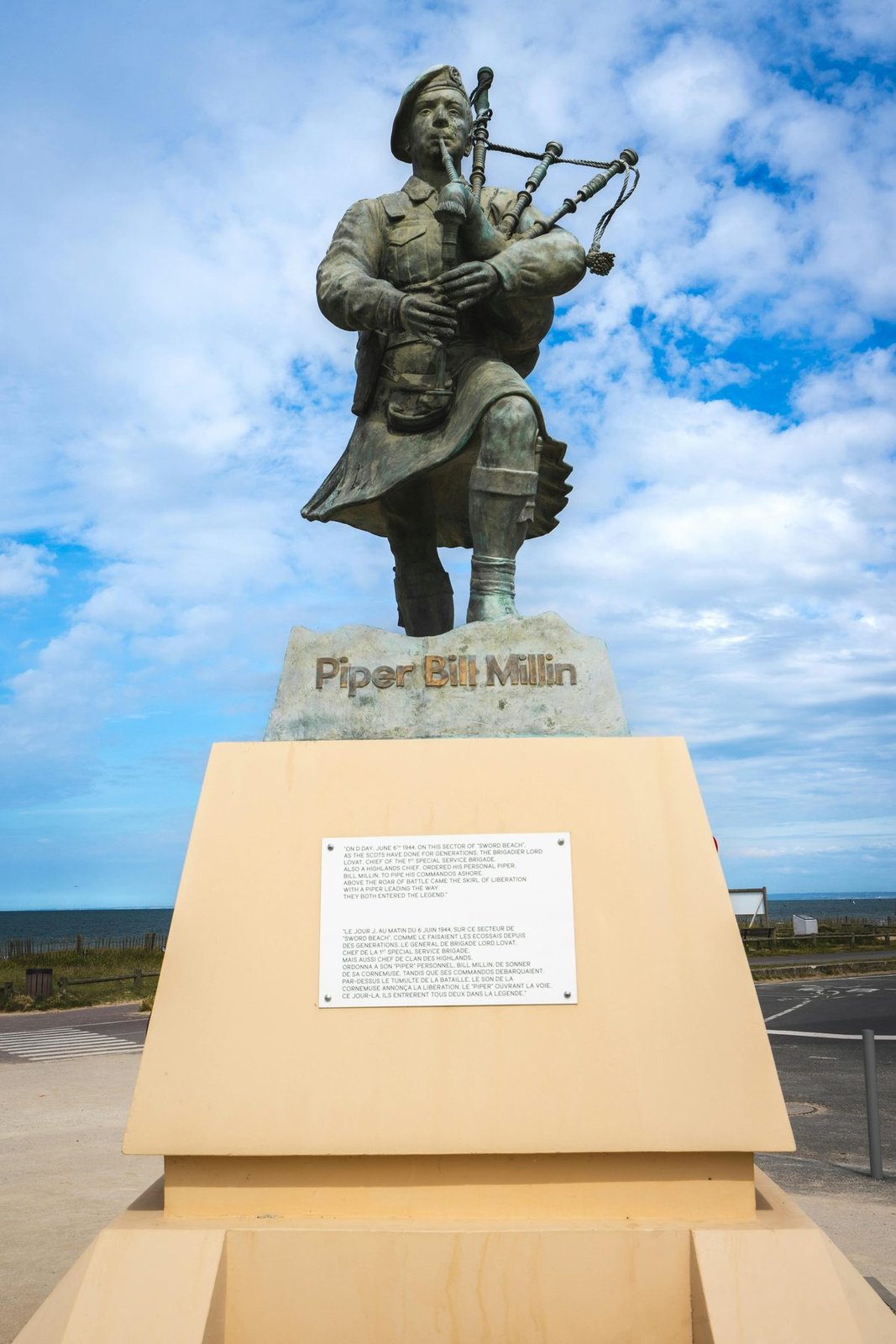
Bill Millin was 21 years old and the personal piper to Brigadier Simon Fraser, 15th Lord Lovat, commanding officer of the 1st Special Service Brigade. Millin had been born in Regina, Saskatchewan, to Scottish parents, and raised in Glasgow. He was, as nearly as anyone can be, a product of the piping tradition in its exact period of transition: a young man trained between the wars on an instrument the army had officially stopped sending into combat.
On the morning of D-Day, as the landing craft approached Sword Beach, Lovat turned to Millin and asked him to pipe the brigade ashore. Millin reminded him of the War Office order. Lovat's reply has become one of the most-quoted lines in all of modern piping history.
"Ah, but that's the English War Office. You and I are both Scottish, and that doesn't apply." — Simon Fraser, 15th Lord Lovat, to Piper Bill Millin, June 6, 1944
Millin waded ashore in his Cameron tartan kilt, the same kilt his father had worn in Flanders in the First World War. He was armed only with his bagpipes and the sgian-dubh in his stocking. He played "Hielan' Laddie" as he stepped onto the beach, then "The Road to the Isles" as he walked the length of Sword Beach, three times, under active fire. Men around him died. He was not touched.
He later spoke to some of the German soldiers who had been in the beach defenses that morning. They told him they had not fired at him. They thought he was mad, and they did not shoot mad men.
Millin went on through the rest of the Normandy campaign with Lovat's brigade. He survived the war, became a hospital orderly in England, and quietly worked for decades before the story worked its way into the broader memory of D-Day. France awarded him the Légion d'honneur in 2009. He died in 2010, at 88. The statue in the photograph above was unveiled at Colleville-Montgomery, just above the beach he walked, in 2013.
Why the name still carries
The label warpipe outlasted the role that gave it the name. The instrument is still loud enough to be heard half a mile away, but it is now much more likely to be heard at a funeral, a civic parade, a memorial service, or a small Saturday competition field than on an active battlefield. Bill Millin was almost certainly the last piper to lead troops into an active beach landing, and that was more than eighty years ago.
And yet, when a pipe band plays "Flowers of the Forest" at a military funeral, or when a lone piper plays "Amazing Grace" at a memorial on a November morning, the word warpipe is doing real work. The instrument has a documented four-century history of walking into gunfire. Most of the tunes are older than the country they are being played for. Part of why the sound carries weight at a memorial is that it carried the same weight on a parapet at Loos. The people in the room may not know the history in any detail. The sound does that work for them anyway.
The companion myth, the one we have already written about, is that the pipes were legally declared weapons of war by the Act of Proscription in 1746. They were not. But the word warpipe was earned on actual ground, by pipers whose names we know. Laidlaw climbed a parapet at Loos. Richardson went back for his pipes. Millin walked the beach three times. They, and the roughly five hundred of their predecessors and contemporaries who did not come home, are what we are referring to when we call the instrument a warpipe.
It is worth knowing that the next time you pick one up.
Sources & Further Reading
- The Piper Bill Millin (Wikipedia)
- The Piper Daniel Laidlaw (Wikipedia)
- The Piper James Cleland Richardson (Wikipedia)
- The Tradition Canadian Pipers in World War I (Wikipedia)
- The Losses Chanters Silenced: Pipers Lost in the Great War (pipes|drums)
- The Statue The Piper Bill Millin Statue, Colleville-Montgomery
- The Sound P/M Harry Lunan, Gordon Highlanders (Alberta Pipe Bands)
- The Historian How Pipers Called the Shots at the Somme (The Scotsman)
- The Family Son of Mad Piper Bill Millin Reveals PTSD Struggle of D-Day Hero (The Scotsman)
- The Sound 'Bagpipes Gave Soldiers Courage' -- Col. Bob Stewart in the Commons (The Times)
- The Reputation Devils in Skirts and Ladies from Hell (Rob Schäfer)
- The Reputation Ladies from Hell: Bagpipers Led the Charge During WWI (HistoryNet)
- Related Essay The Bagpipes Were Never Banned (Not Exactly)